
The global market for dehydrated vegetables is expanding as consumers seek healthy, long-shelf-life snacks. But how is factory dehydrating carrot chips achieved at a commercial scale while maintaining color and nutrients? The answer lies in the precision of the carrot chips dehydrator. Unlike home drying, industrial dehydration requires a synchronized production line where temperature, airflow, and humidity are meticulously controlled to produce a premium product.
In this guide, we will explore the professional process of large-scale carrot dehydration and the critical role of the carrot chips dehydrator in ensuring consistent quality.
1. Raw Material Selection and Pre-processing
The quality of dehydrated carrots starts in the field. To ensure the best results from your carrot chips dehydrator, factories select carrots with high carotene content and firm texture.
- Washing & Peeling: Carrots are thoroughly cleaned using bubble washers and brush peelers.
- Precision Slicing: To ensure even drying, carrots are sliced into uniform thicknesses (typically 2mm to 4mm). If the slices are inconsistent, the carrot chips dehydrator will struggle to dry them uniformly, leading to some pieces being burnt while others remain moist.
2. Blanching: The Secret to Color Retention
How is factory dehydrating carrot chips kept so vibrant? The secret is blanching. Before entering the carrot chips dehydrator, slices are treated with hot water or steam (85°C–95°C). This process:
- Inactivates enzymes that cause browning.
- Softens the cell structure to allow moisture to escape more easily.
- Enhances the rehydration properties of the final product.
3. The Dehydration Phase: Using the Carrot Chips Dehydrator
This is the most critical stage. An industrial carrot chips dehydrator (usually a continuous belt dryer ) uses a controlled thermal cycle.
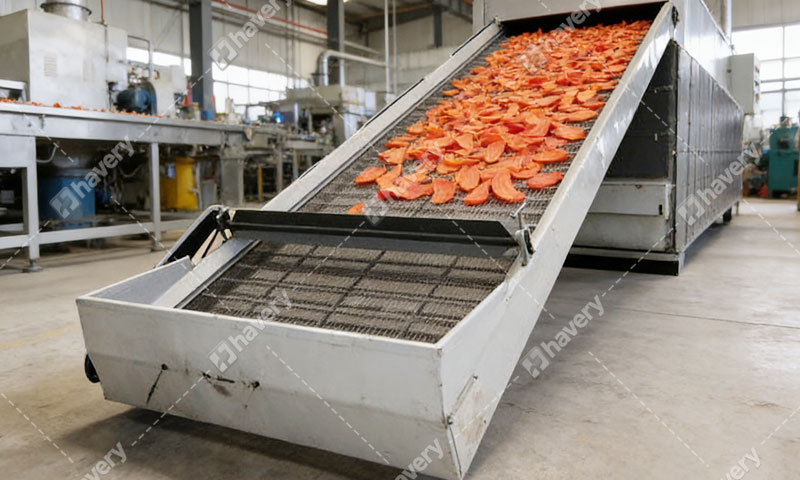
Controlled Temperature Zones
A high-end carrot chips dehydrator operates in multiple stages. Initially, a higher temperature (around 70°C) is used to remove surface moisture quickly. As the process continues, the carrot chips dehydrator lowers the temperature to 55°C–60°C to prevent “case hardening,” where the outside dries too fast and traps moisture inside.
Optimized Airflow
How is factory dehydrating carrot chips made efficient? It’s through horizontal or vertical forced airflow. The carrot chips dehydrator ensures that hot air passes through every layer of the product, carrying away moisture at a steady rate.
4. Why the Right Carrot Chips Dehydrator Matters
When investing in a carrot chips dehydrator, factories look for three main technical features:
- Energy Efficiency: Modern heat pump technology in a carrot chips dehydrator can save up to 60-75% in energy costs compared to traditional electric heating.
- Humidity Control: An advanced carrot chips dehydrator automatically exhausts humid air while recirculating dry, hot air.
- Stainless Steel Construction: To meet international food safety standards (FDA/CE), the carrot chips dehydrator must be built with SUS304 stainless steel.
5. Cooling and Final Packaging
Once the moisture content reaches the target (usually 5%–8%), the chips leave the carrot chips dehydrator. They must be cooled rapidly to room temperature before packaging to prevent condensation inside the bags.
Conclusion: Investing in Commercial Dehydration
Understanding how is factory dehydrating carrot chips allows producers to optimize their workflow and reduce waste. The heart of this operation is the carrot chips dehydrator, a machine that balances heat and time to preserve the carrot’s natural essence.
Ready to start your dehydration project? Selecting the right carrot chips dehydrator is essential for your factory’s ROI. Whether you need a small batch dryer or a fully automated continuous line, our team can help.
Leave a comment below with your daily production requirements, and our engineers will provide a custom configuration for your next carrot chips dehydrator!