
The carrot powder machine price is one of the most frequently asked questions among food processors, spice manufacturers, and small-to-medium enterprises looking to enter the powdered vegetable market. If you have been searching for a reliable solution to turn fresh carrots into fine, free-flowing powder, you have likely noticed that prices vary dramatically across suppliers — sometimes by several thousand dollars for machines that look nearly identical on the outside.
To give you a realistic expectation before we dive deeper, a commercial-grade stainless steel carrot powder machine price ranging from a few thousand to over ten thousand US dollars., depending on capacity, build quality, and customization. Entry-level models suitable for pilot testing and small batches start around a few thousand US dollars, while industrial units designed for continuous, high-volume production can easily exceed over ten thousand US dollars.
But why such a wide gap? The truth is that the price tag tells only half the story. The carrot powder machine price is shaped by a cluster of engineering factors that directly determine output quality, durability, food safety, and day-to-day operating cost. Below, we break down the key variables that influence pricing on the machine you see here.
1. Food-Grade Stainless Steel Construction and Material Thickness
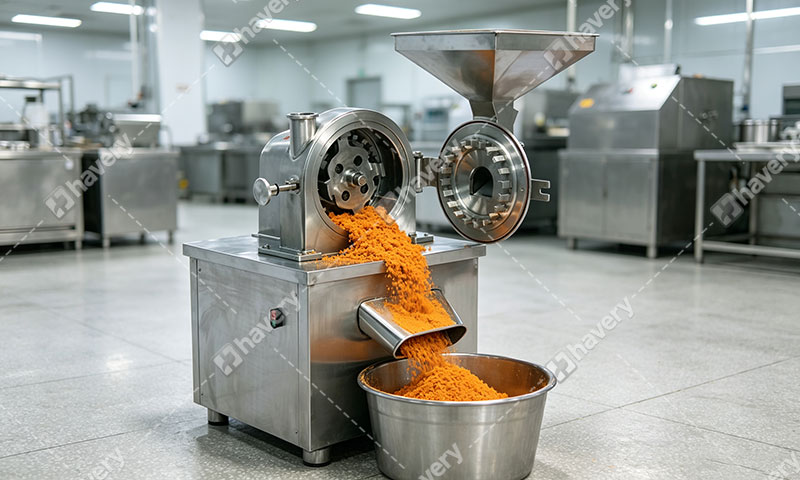
The very first factor pushing up — or pulling down — a carrot powder machine price is the grade and thickness of the stainless steel used. The grinding machine in our image is built with a polished body, an openable circular front cover, and a sturdy rectangular base, all of which point to food-contact-grade SS304 (or even SS316) construction.
Because carrots carry a naturally high moisture and sugar content, they are prone to sticking, caking, and microbial growth on machine surfaces. A machine fabricated from thicker SS304 plate resists corrosion, prevents juice and pulp from seeping into welds, and cleans far more easily after every batch. Machines that cut corners with thinner sheet metal or lower-grade alloys are cheaper upfront — but they warp, corrode, and harbor bacteria quickly when handling wet root vegetables, costing you far more in the long run.
2. Chamber Design and Grinding Mechanism — the Heart of Carrot Powder Quality
Take a close look at the open chamber in the image: you can see radiating ridges on the grinding plate and multiple blades or hammers arranged in a circular pattern around the central axis. This is not decoration — this geometry is what turns fibrous, moisture-laden carrot chunks into consistent powder.
Carrot fiber is notoriously tough and stringy, which means an ordinary blade mill will tear the material unevenly, leaving coarse filaments mixed with fine dust. Higher-priced machines use a beater/hammer configuration combined with a toothed grinding disc that first shreds the carrot, then shears and refines it repeatedly until the particle size becomes uniform. The more precisely matched the blade clearance and rotation speed, the finer and more repeatable the output — and the higher the machine’s manufacturing cost.
3. Yield Rate and Loss Control on Sticky Raw Material
One of the most overlooked cost drivers behind a carrot powder machine price is material yield. Carrots release sticky juice the moment they are cut, which tends to cling to internal walls and clog screens in cheap machines — resulting in 10–20% product loss and frequent downtime for manual scraping.
An engineered machine reduces this waste through controlled airflow, optimized residence time inside the chamber, and discharge channels designed to prevent buildup. When a carrot processor calculates that a slightly pricier machine saves even 8% of raw material per shift, the difference in purchase price is often recovered within the first seasons of operation. That is why quality-focused suppliers charge more — because their machines actually deliver more usable powder per kilogram of input.
4. Production Capacity and Motor Power (/kgMattersMoreThan/Unit)
The image shows a compact hopper atop the grinding chamber feeding into the machine — a configuration that indicates a moderate batch capacity machine. Capacity directly scales the motor power, chamber volume, and structural reinforcement required, and it is the single largest driver of absolute price.
Rather than comparing total price alone, professional buyers compare cost per kilogram of finished carrot powder per hour. A few thousand US dollars unit processing 50 kg/h costs US$80 per kg·h of capacity, while a over ten thousand US dollars unit processing 500 kg/h costs just US$30 per kg·h. As your production demand grows, investing in higher capacity per unit of price becomes the more economical decision — which is exactly why suppliers segment their carrot powder machine price tiers by throughput.
5. Food Safety, Sealing, and Cleanability
Regulatory compliance is non-negotiable in powdered food production, and it directly shows up in price. Look at the design details in our image: the circular front cover with its handle/knob that opens for inspection and cleaning is a deliberate feature. Machines sell for less when the internals are hard to reach, forcing operators to spend hours disassembling hidden fasteners just to sanitize the chamber between carrot and spice batches.
Premium machines incorporate quick-release covers, food-grade gaskets and seals that prevent fine powder from leaking into bearings, and rounded internal corners with no dead zones where carrot pulp or dust could accumulate. These details raise manufacturing complexity and price, but they are essential for meeting HACCP, FDA, and EU food-contact standards — and for protecting your brand from contamination recalls.
6. Motor Efficiency, Energy Consumption, and Duty Cycle
Carrots, being fibrous and moist, place a heavy load on the motor. Inexpensive units often pair a small motor with a high-speed blade, which overheats during continuous runs and must pause frequently — slowing production and increasing wear. A higher-priced machine, like the one shown with its robust enclosed base housing, uses a properly matched motor with adequate thermal protection. It runs continuously at lower energy per kilogram, generates less heat that could degrade carrot nutrients, and extends the lifespan of both blades and bearings. Over a machine’s multi-year life, electricity and replacement-part savings can easily offset a higher initial carrot powder machine price.
7. After-Sales Support, Spare Parts, and Warranty
Finally, a significant and sometimes hidden portion of carrot powder machine price lies in what happens after you pay. Because carrot’s sugars and fibers wear down blades faster than most grains, you will regularly need replacement grinding plates, hammers, and seals. Lower-priced machines from anonymous sources often leave buyers stranded when parts are discontinued or support is unresponsive.
Established suppliers bake into the price their inventory of spare parts, bilingual technical documentation, installation guidance, and responsive warranty service — ensuring your production line never sits idle waiting for a spare hammer. This “cost of true ownership” is frequently the deciding factor for buyers who have been burned by cheap imports before.
Conclusion: Buy for Total Cost of Ownership, Not Just the Sticker
To summarize, the carrot powder machine price of the stainless steel carrot grinding unit discussed above is, in essence, a reflection of seven engineering realities: the food-grade steel quality, the precision of the blade-and-disc grinding mechanism, the achievable material yield on sticky carrots, the production capacity per unit of investment, food-safety sealing and cleanability, motor efficiency and duty cycle, and the strength of after-sales support. A machine that looks identical from the outside can differ by thousands of dollars once these factors are accounted for — and in a demanding application like carrot powder production, the cheapest machine is rarely the most economical one.
If you are planning to process carrots — or other high-moisture, fibrous vegetables such as ginger, garlic, or onion — into fine, uniform powder, we invite you to make an informed decision rather than chasing the lowest quote.
👉 Found this breakdown helpful? Please share this article with your colleagues and fellow food processors so they, too, can avoid overpaying for an underperforming machine.
💬 And don’t just read — leave us a comment below! Tell us the capacity and moisture content you are working with, and our engineering team will respond with the ideal configuration, a customized quotation, and detailed technical specifications for your exact carrot powder machine needs. We look forward to hearing from you!